
Free Chemistry NEET Notes for Redox Reactions
Free Chemistry Notes available for Redox Reactions (NEET)
Power up your NEET Exam prep with Chapter-Wise Chemistry Notes for Redox Reactions at Onlineneetcoaching.in. Crafted by Brilliant Tutorial experts with 25 years of NEET insights.
- Redox Reactions -
Important Chemistry Notes for IITJEE/NEET Preparation- Redox Reactions
Class 11 Chemistry is a broad subject that requires a thorough understanding of the concepts and topics covered. As a result, we have provided Chemistry Notes PDF for IIT JEE/NEET to students and NEET aspirants. Redox Reactions Class 11 Notes PDF for NEET can be found below. With the help of detailed syllabus, Class 11 students learn what they need to study, how many points are assigned to each unit, and how much time is allotted for each unit. As a result, they can easily plan their study schedule.
Check out the Redox Reactions Class 11 notes PDF for your IIT JEE/NEET Preparation based on the IIT JEE/NEET Chemistry Syllabus. The Redox Reactions notes PDF is designed in such a way that it is very useful for IIT JEE/NEET aspirants.
REDOX REACTION
OXIDATION
- Addition of oxygen.
 2MgO
2MgO- Removal of hydrogen
 2N2 + 6H2O
- Addition of electronegative portion
 CuCl2
CuCl2- Removal or decrease in the electropositive portion
 2 HCl + S
- De - electronation

REDUCTION
- Addition of hydrogen
 2NH3
2NH3- Addition of electropositive portion
 Cu2Cl2
- Removal of oxygen
 Cu + H2O
- Removal or decrease in the electronegative portion
 Hg2Cl2 + SnCl4
- Electronation
M + ne–Mn–
OXIDANT OR OXIDISING AGENT
REDUCTANT OR REDUCING AGENT
REDOX REACTIONS
 SnCl4 + Hg2Cl2
TYPES OF REDOX REACTIONS
- Intermolecular redox reactions - In this case one substance is oxidised and another is reduced.
 MnCl2 + Cl2 + 2H2O
- Disproportionation - In this case the same substance is oxidised and reduced eg.

- Intramolecular redox reactions - In this case one element of the compound is reduced while another element of the same compound is oxidised

OXIDATION NUMBER
element during its change from free state in a particular compound.
RULES FOR DETERMINING OXIDATION NUMBER
- O.N. of elements in free state is zero eg
- O.N. of hydrogen is always +1 except in ionic metal hydrides where it is – 1.
- O.N. of oxygen is –2 except in OF2 where it is + 2 and in peroxides where it is – 1.
- O.N. of metals is always +ve. For IA group elements it is +1 and for IIA group elements it is +2.
- O.N. of halogens is –1 in metal halides.
- O.N. of ion or radical is the number of electrons it must gain or lose to acquire neutrality i.e. it is equal to the electric charge for
is –2.
- O.N. of an atom within compound can be +ve, –ve integer, zero or fraction.
- The algebraic sum of all the O.N. of elements is equal to zero.
- The algebraic sum of all the O.N. of elements in an ion is equal to net charge on the ion.
- Maximum O.N. of an element is equal to number of valence electrons i.e. group number.
- Minimum O.N. of an element (except metals) = (8 – group number).
- In metal corbonyl, and amalgams, O.N. of metals is zero.
COVALENCY AND OXIDATION STATE
- Covalency : It is the number of hydrogen atoms which can combine with a given atom
- Oxidation state : It is defined as the O.N. per atom.
STOCK NOTATION
CHEMICAL BONDING METHOD FOR DETERMINATION OF OXIDATION NUMBER
- For one covalent bond assign one unit negative charge to electronegative atom and one unit positive charge to less electronegative atom e.g. (electronegativity A> B).
- No charge when the covalent bond is between like atoms.
- In case of coordinate bond assign two unit negative charge to acceptor atom and two unit positive charge to donor atom e.g. (electronegativity A > B).
- No charge when donor in coordinate bond is more electronegative than acceptor eg (electronegativity A > B).
- When coordinate bond is between similar atoms assign two unit negative charge to acceptor and two unit positive charge to donor e.g. (electronegativity same).
CALCULATION/ DETERMINATION OF OXIDATION NUMBER OF UNDERLINED ELEMENT IN SOME COMPOUNDS

- KMnO4
- H2SO4
- NH4NO3
Split into two ions NH4+ and NO3-

- HNO3
- KI3
- NaO2
It is super oxide.
- Fe3O4
It is mixed oxide FeO.Fe2O3 and Fe has O.N. +2 and +3 respectively.




- N3H (hydrazoic acid)
- K4[Fe(CN)6]
- CrO5
Let the O.N. of Cr be x then
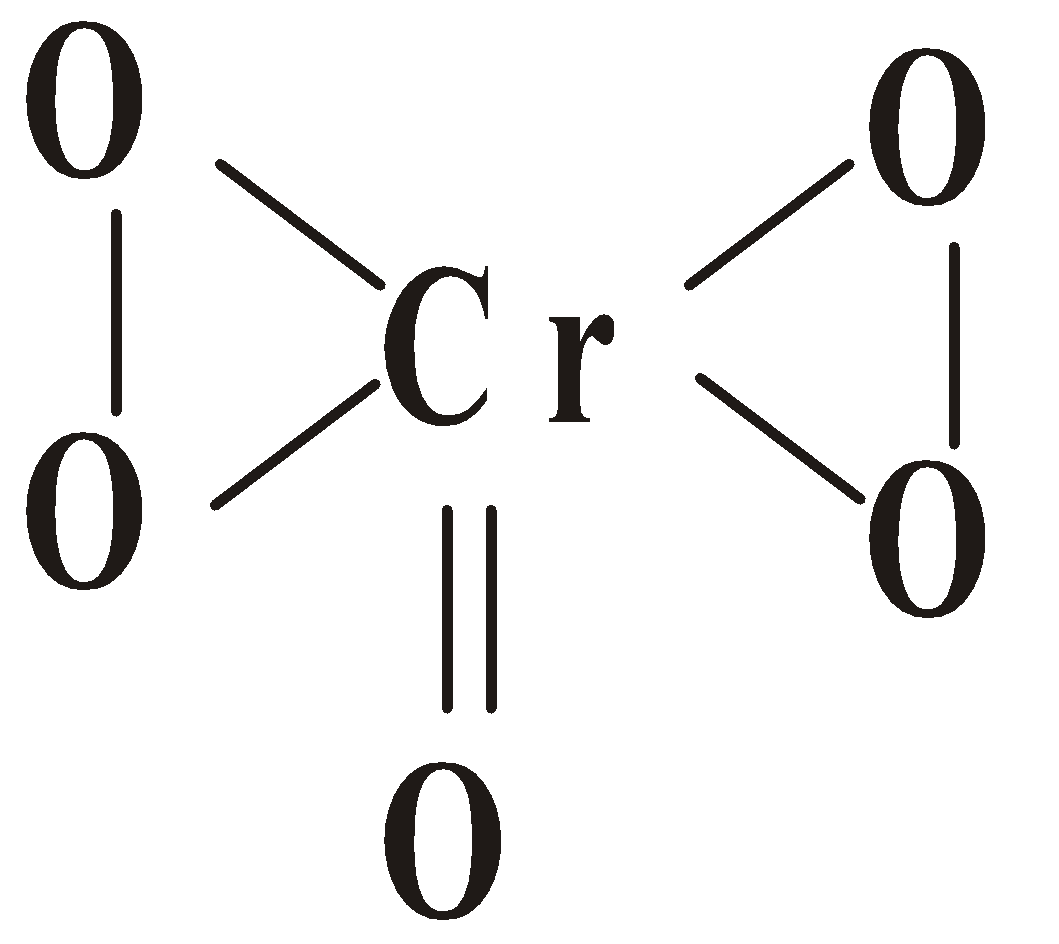
- HCN
Its structure is H – C N
- H – N ≡ C
for H – N bond H = +1, N = –1
- H2SO5 (Caro acid) - Write structure and apply chemical bond method

- Na2S2O3


- Na2S4O6
Sodium tetra thionate - its structure is as follows

- CaOCl2
Its structure is
- O3
The structure of O3 is
OXIDATION NUMBER CONCEPT OF OXIDANT (OXIDISING AGENT) AND REDUCTANT (REDUCING AGENT)
- Oxidising agent : A substance can act as oxidising agent if the oxidation number of one of its element is maximum eg HNO3 (O.N. of N = 5 which is maximum value)
- Reducing agent : A substance can act as reducing agent if the oxidation number of one of its element is minimum eg SnCl2 (O.N. of Sn = 2 which is minimum value), FeSO4, Na2S2O3, H2S, H2C2O4 Electronegative elements I-, Br–, N3– are powerfully reducing in nature.
- Reducing as well as oxidising agent : A substance that can act as both, reducing as well as oxidising agent if O.N. of one of its element is in between the maximum and the minimum value eg HNO2 (O.N. of N = +3 which is intermediate of +5 and 0).
OXIDATION NUMBER AND ACID STRENGTH

EQUIVALENT WEIGHT OF AN OXIDISING AGENT




EQUIVALENT WEIGHT OF REDUCING AGENT


BALANCING OF CHEMICAL EQUATIONS
OXIDATION NUMBER METHOD
- Assign oxidation number to the atoms showing a change in oxidation state.
- Balance the total number of atoms undergoing change in oxidation state.
- Balance the number of electrons gained and lost.
- Balance [O] on both sides by adding H2O.
- Balance H atoms by adding H+ ions
- If the reaction proceeds in basic solution add sufficient number of OH– ions on both sides
ION ELECTRON METHOD
- Split up the reaction into two half reactions showing oxidation and reduction separately.
- Balance number of atoms undergoing the change of oxidation state.
- Balance O on both sides by adding H2O.
- Balance H atoms by adding H+ ions.
- Balance charge by adding required number of electrons
- Make the number of electrons equal in two half reactions by multiplying with suitable coefficient.
- Add the two half reactions