
Free Physics NEET Notes for Electric Charges And Fields
Free Physics Notes for Electric Charges And Fields (NEET)
Power up your NEET Exam prep with Chapter-Wise Physics Notes for Electric Charges And Fields at Onlineneetcoaching.in. Crafted by Brilliant Tutorial experts with 25 years of NEET insights.
- Electric Charges And Fields -
Important Physics Notes for IITJEE/NEET Preparation- Electric Charges And Fields
Class 12 Physics is a broad subject that requires a thorough understanding of the concepts and topics covered. As a result, we have provided Physics Notes PDF for IIT JEE/NEET to students and NEET aspirants. Electric Charges And Fields Class 12 Notes PDF for NEET can be found below. With the help of detailed syllabus, Class 12 students learn what they need to study, how many points are assigned to each unit, and how much time is allotted for each unit. As a result, they can easily plan their study schedule.
Check out the Electric Charges And Fields Class 12 notes PDF for your IIT JEE/NEET Preparation based on the IIT JEE/NEET Physics Syllabus. The Electric Charges And Fields notes PDF is designed in such a way that it is very useful for IIT JEE/NEET aspirants.
ELECTRIC CHARGES AND FIELDS
ELECTRIC CHARGE
Charge is something associated with matter due to which it produces and experiences electric and magnetic effects.
There are two types of charges :
-
Positive charge
-
Negative charge
Positive and negative charges : Positive charge means the deficiency of electrons while negative charge means excess of electrons. In any neutral body the net charge is equal to zero
i.e., the sum of positive charges is equal to the sum of negative charges.
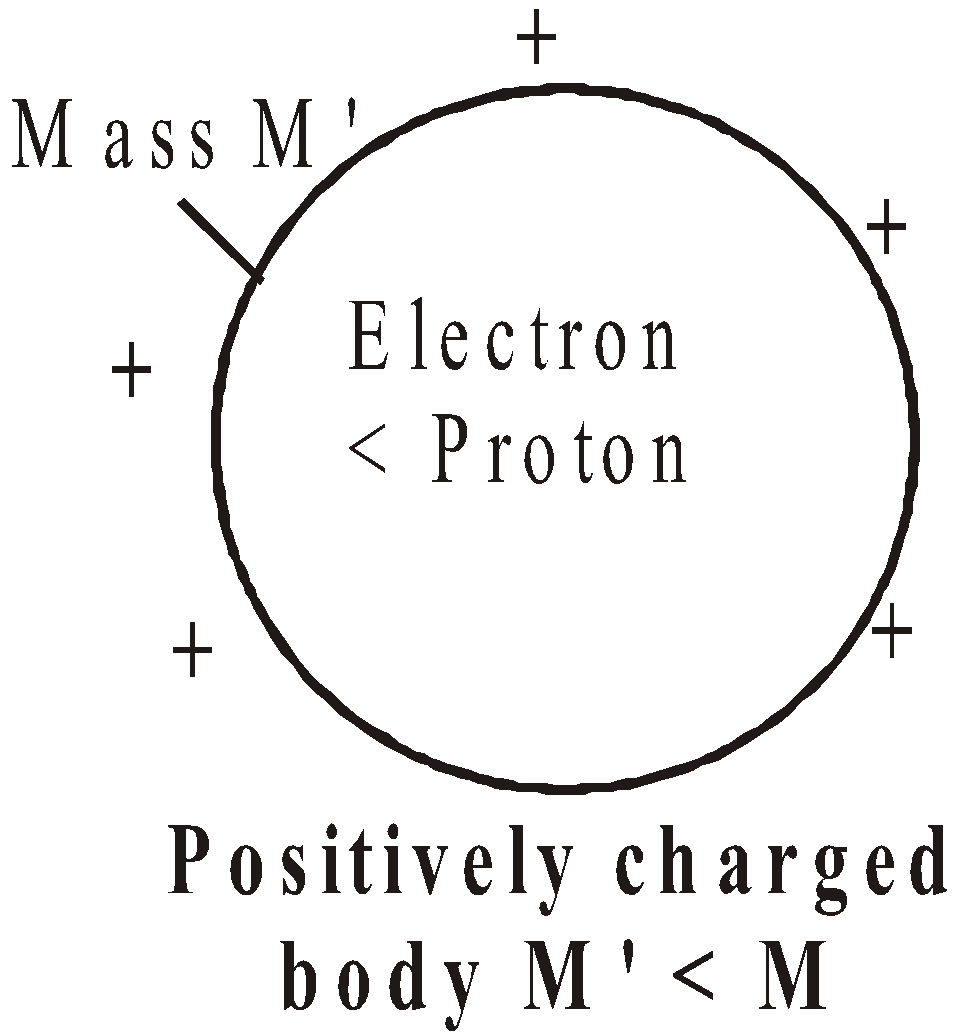
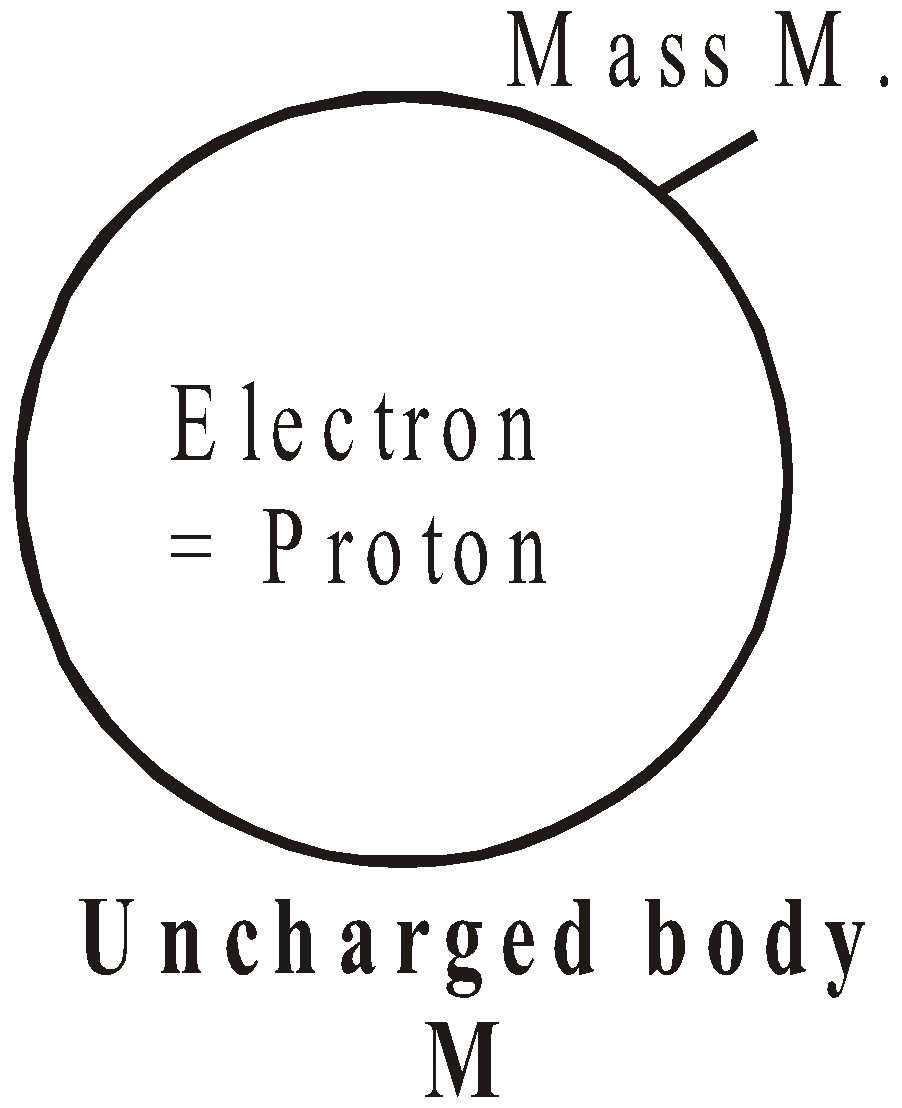
 Charge is a scalar quantity and its SI unit is coulomb (C).
CONDUCTORS AND INSULATORS
The materials which allow electric charge (or electricity) to flow freely through them are called conductors. Metals are very good conductors of electricity. Silver, copper and aluminium are some of the best conductors of electricity. Our skin is also a conductor of electricity. Graphite is the only non-metal which is a conductor of electricity.
All metals, alloys and graphite have 'free electrons', which can move freely throughout the conductor. These free electrons make metals, alloys and graphite good conductor of electricity.
Aqueous solutions of electrolytes are also conductors.
The materials which do not allow electric charge to flow through them are called non-conductors or insulators.
For example, most plastics, rubber, non-metals (except graphite), dry wood, wax, mica, porcelain, dry air etc., are insulators.
Insulators can be charged but do not conduct electric charge. Insulators do not have 'free electrons' that is why insulators do not conduct electricity.
Induced charge can be lesser or equal to inducing charge (but never greater) and its max. value is given by
Q' = – Q (1 – 1/k), where 'Q' is inducing charge and 'K' is the dielectric const. of the material of the uncharged body.
For metals k = ∞ ⇒ Q' = – Q.
METHODS OF CHARGING
-
By friction : By rubbing two suitable bodies, given in box one is charged by +ve and another by –ve charge in equal amount.
+ve : Glass rod, Fur, Dry hair, Wool
-ve : Silk, Ebonite rod, Comb, Amber
Note:- Electric charges remain confined only to the rubbed portion of a non-conductor but in case of a conductor, they spread up throughout the conductor.
-
By conduction : Charging a neutral body by touching it with a charged body is called charging by conduction.
It is important to note that when the bodies are charged by conduction, a charged and an uncharged bodies are brought into contact and then separated, the two bodies may or may not have equal charges.
If the two bodies are identical the charges on the two will be equal.
If the two bodies are not identical, the charges will be different.
The potential of the two bodies will always be the same.
-
By induction : Charging a body without bringing it in contact with a charged body is called charging by induction.
 First rearrangement of charge takes place in metal rod B. When the rod B is connected to earth, electrons flow from earth to the rod B thus making it -vely charged
The magnitude of elementary positive or negative charge (electron) is same and is equal to 1.6 × 10⁻¹⁹ C.
First rearrangement of charge takes place in metal rod B. When the rod B is connected to earth, electrons flow from earth to the rod B thus making it -vely charged
The magnitude of elementary positive or negative charge (electron) is same and is equal to 1.6 × 10⁻¹⁹ C.
PROPERTIES OF ELECTRIC CHARGE
-
Similar charges repel and dissimilar charges attract each other.

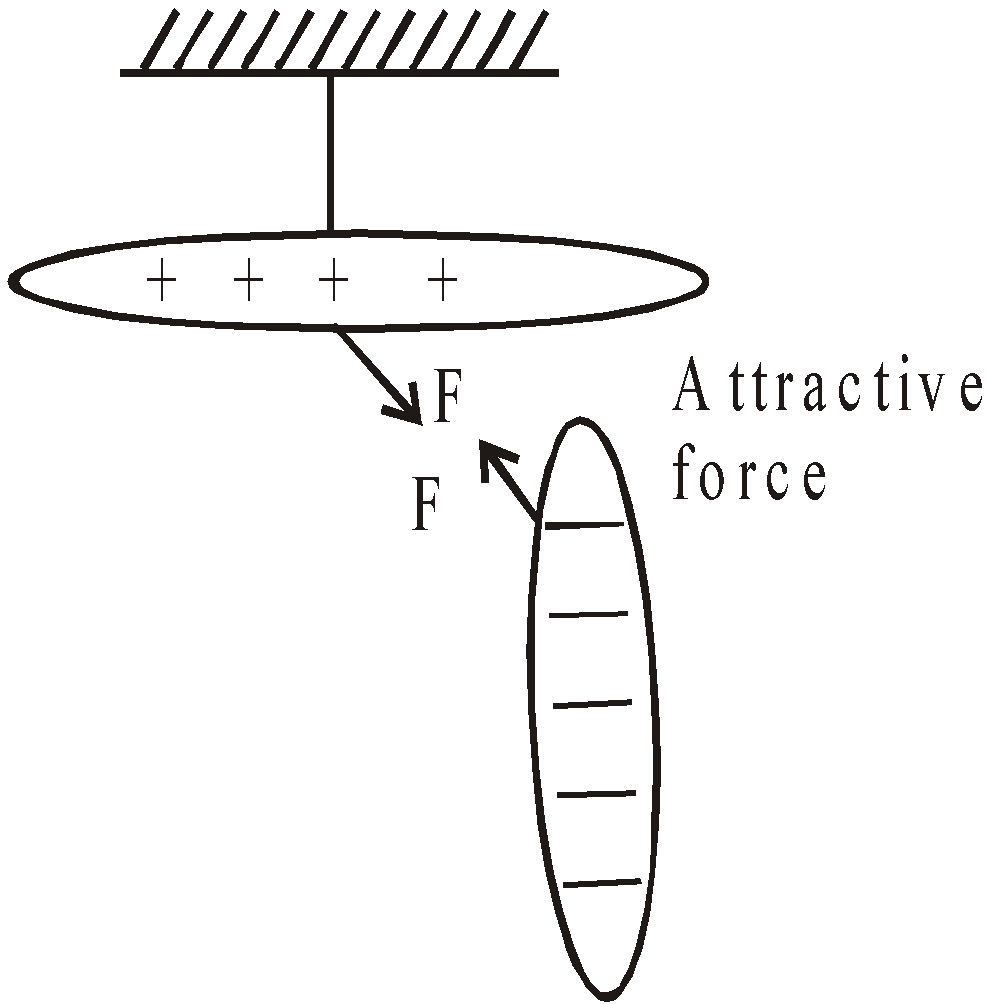 In rare situation you may find similar charged bodies attracting each other. Suppose a big positive charged body is placed near a small positively charged body then because of induction, opposite charge produced on the small body makes it to attract the other body.
-
A charged body attracts light uncharged bodies, due to polarisation of uncharged body.
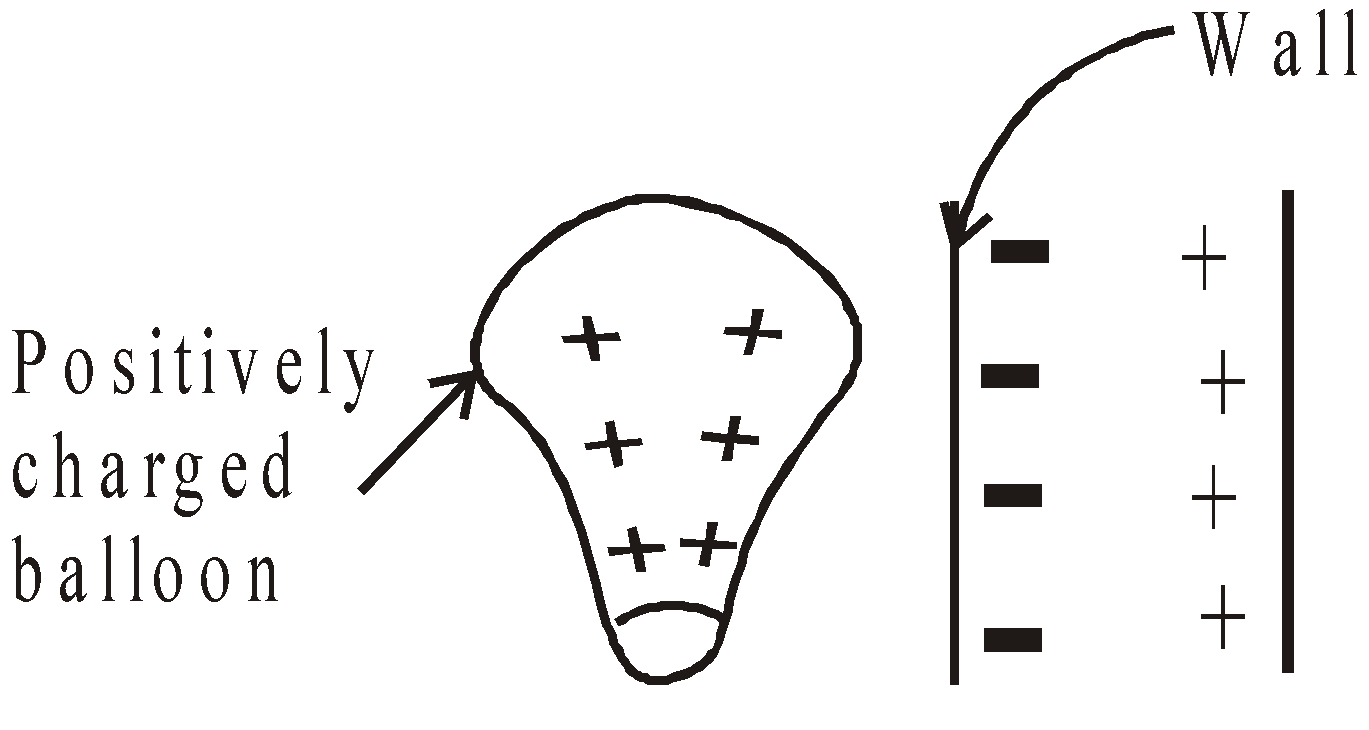 Fig : When a positively charged balloon is placed in contact with the wall, an opposite charge is induced with the wall, the balloon stick to the wall due to electrostatic attraction
-
Charge is conserved i.e., the charge can neither be created nor be destroyed but it may simply be transferred from one body to the other.
Thus we may say that the total charge in the universe is constant or we may say that charges can be created or destroyed in equal and opposite pair. For example

 (Pair-production process)
Positron is an antiparticle of electron. It has same mass as that of electron but equal negative charge.
(Pair-production process)
Positron is an antiparticle of electron. It has same mass as that of electron but equal negative charge.
 (Pair-annihilation process)
-
Charge is unaffected by motion
This is also called charge invariance with motion
Mathematically, (q)at rest = (q)in motion
-
Quantisation of charge - A charge is an aggregate of small unit of charges, each unit being known as fundamental or elementary charge which is equal to e = 1.6 × 10⁻¹⁹ C. This principle states that charge on any body exists as integral multiple of electronic charge. i.e. q = ne where n is an integer.
According to the concept of quantisation of charges, the charge q cannot go below e. On macroscopic scale, this is as good as taking limit q0 → 0.
Quantisation of electric charge is a basic (unexplained) law of nature. It is important to note that there is no analogous law of quantisation of mass.
Recent studies on high energy physics have indicated the presence of graphs with charge 2e/3, e/3. But since these cannot be isolated and are present in groups with total charge, therefore the concept of elementary charge is still valid.
COULOMB’S LAW
The force of attraction or repulsion between two point charges (q1 and q2) at finite separation (r) is directly proportional to the product of charges and inversely proportional to the square of distance between the charges and is directed along the line joining the two charges.
i.e.,  or
or 
 where ε is the permittivity of medium between the charges.
If ε0 is the permittivity of free space, then relative permittivity of medium or dielectric constant (K), is given by
where ε is the permittivity of medium between the charges.
If ε0 is the permittivity of free space, then relative permittivity of medium or dielectric constant (K), is given by
 The permittivity of free space
 and
and  = 9 × 10⁹ Nm2 C–2.
Also
= 9 × 10⁹ Nm2 C–2.
Also in CGS system of unit.
Coulomb’s law may also be expressed as
in CGS system of unit.
Coulomb’s law may also be expressed as
 Let F0 be the force between two charges placed in vacuum then

 Hence
Hence 
 Therefore we can conclude that the force between two
charges becomes 1/K times when placed in a medium of
dielectric constant K.
The value of K for different media

DIELECTRIC
A dielectric is an insulator. It is of two types -
-
Polar dielectric
-
Non-polar dielectric
SIGNIFICANCE OF PERMITTIVITY CONSTANT OR DIELECTRIC CONSTANT
Permittivity constant is a measure of the inverse degree of permission of the medium for the charges to interact.
DIELECTRIC STRENGTH
The maximum value of electric field that can be applied to the dielectric without its electric breakdown is called its dielectric strength.
DIFFERENCE BETWEEN ELECTROSTATIC FORCE AND GRAVITATIONAL FORCE
 Note:- Both electric and gravitational forces follow inverse square law.
VECTOR FORM OF COULOMB’S LAW

SUPERPOSITION PRINCIPLE FOR DISCRETE CHARGE DISTRIBUTION: FORCE BETWEEN MULTIPLE CHARGES
 The electric force on q1 due to a number of charges placed in air or vacuum is given by
 Note:- Coulomb's law is valid if m and if charges are point charges.
FORCE FOR CONTINUOUS CHARGE DISTRIBUTION
A small element having charge dq is considered on the body. The force on the charge q1 is calculated as follows
 Now the total force
  is calculated by integrating
  under proper limits.
i.e.,
under proper limits.
i.e.,  where
where  is a variable unit vector which points from each dq, towards the location of charge q1 (where dq is a small charge element)
TYPES OF CHARGE DISTRIBUTION
-
Volume charge distribution : If a charge, Q is uniformly distributed through a volume V, the charge per unit volume ρ (volume charge density) is defined by
 ; ρ has unit coulomb/m3.

-
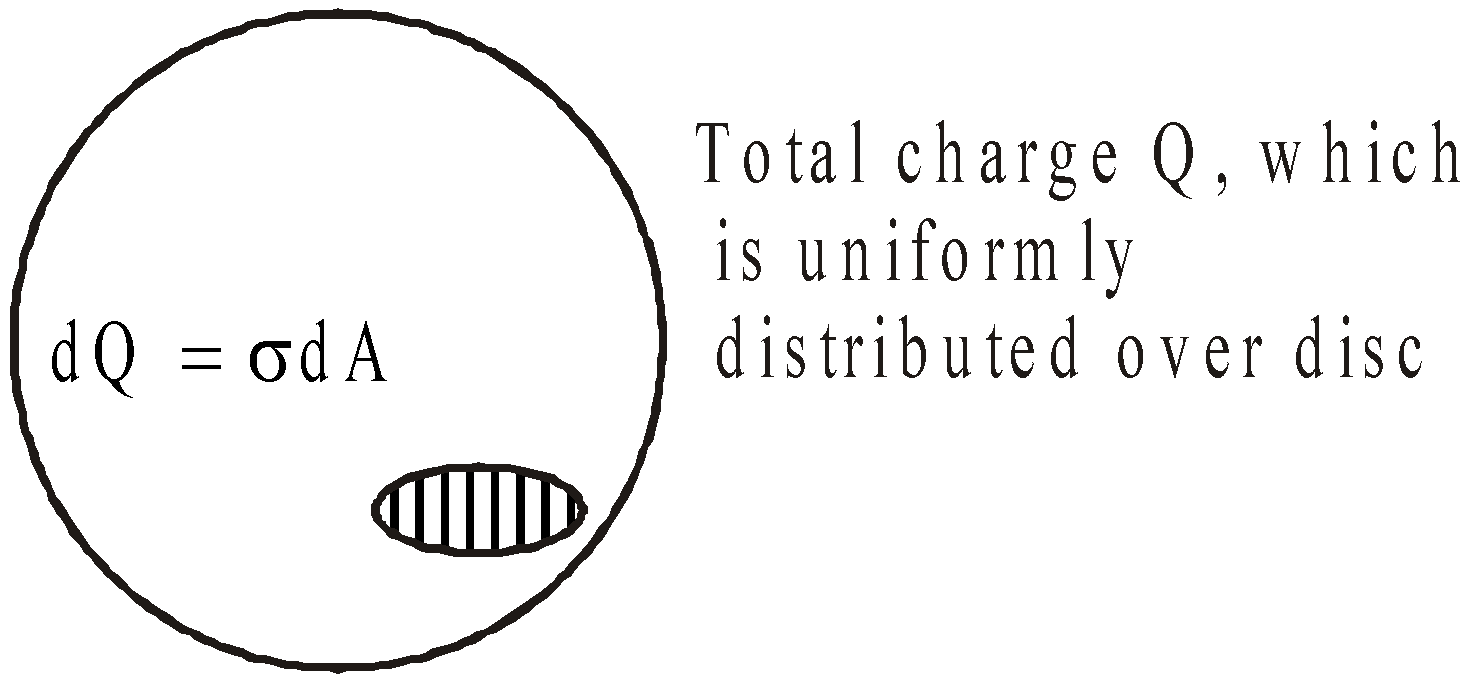
Surface charge distribution : If a charge Q is uniformly distributed on a surface of area A, the surface charge density , is defined by the following equation
 σ has unit coulomb / m2
-
Linear charge distribution : If a charge q is uniformly distributed along a line of length λ, the linear charge density λ, is defined by
 , λ has unit coulomb/m.
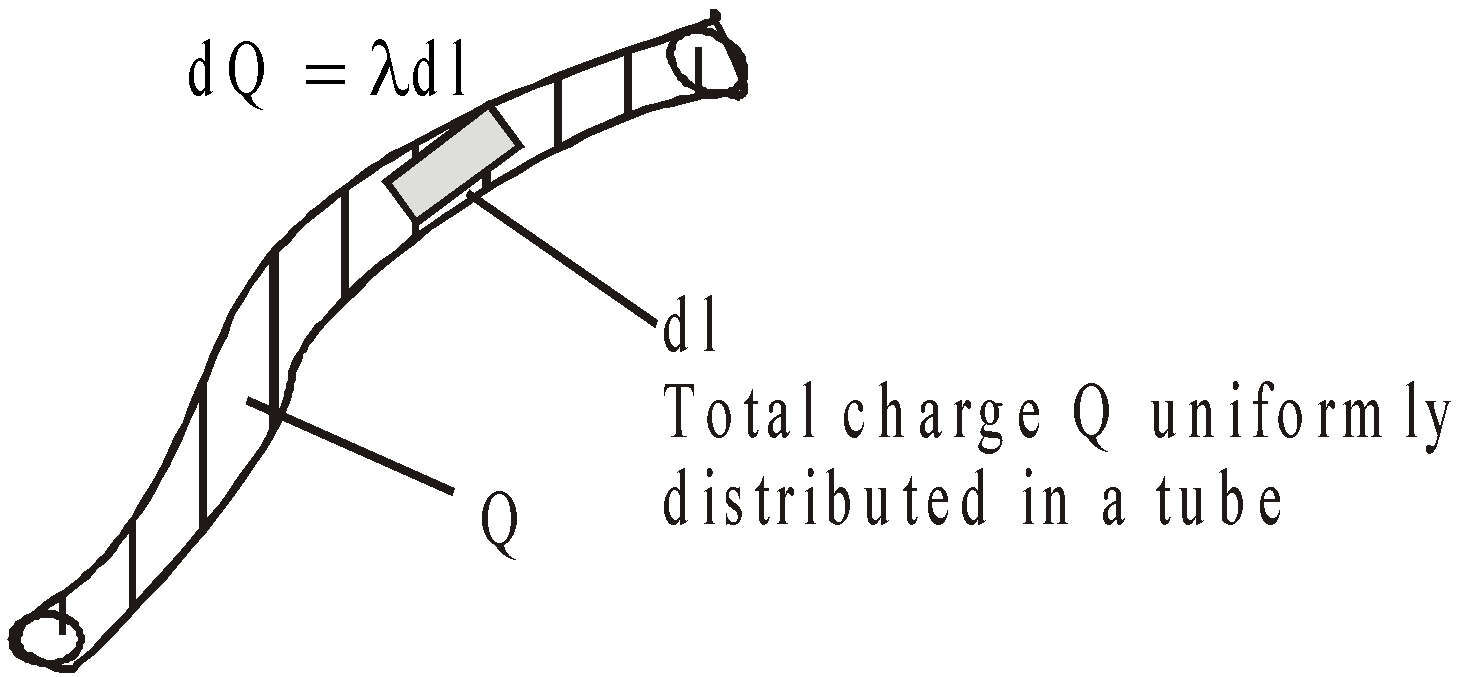
If the charge is non uniformly distributed over a volume, surface, or line we would have to express the charge densities as
 where dQ is the amount of charge in a small volume, surface or length element.
In general, when there is a distribution of direct and continuous charge bodies, we should follow the following steps to find force on a charge q due to all the charges :
-
Fix the origin of the coordinate system on charge q.
-
Draw the forces on q due to the surrounding charges considering one charge at a time.
-
Resolve the force in x and y-axis respectively and find
 and
and 
-
The resultant force is and the direction is given by
 and the direction is given by
CALCULATION OF ELECTRIC FORCE IN SOME SITUATIONS
-
Force on one charge due to two other charges
Resultant force on q due to q1 and q2 are obtained by vector addition of individual forces


 The direction of F is given by
-
Force due to linear charge distribution
Let AB is a long (length ) thin rod with uniform distribution of total charge Q.
 We calculate force of these charges i.e. Q on q which is situated at a distance a from the edge of rod AB.
Let, dQ is a small charge element in rod AB at a distance x from q .
The force on q due to this element will be
We calculate force of these charges i.e. Q on q which is situated at a distance a from the edge of rod AB.
Let, dQ is a small charge element in rod AB at a distance x from q .
The force on q due to this element will be

 where μ is linear charge density i.e., μ = Q / .
so,
where μ is linear charge density i.e., μ = Q / .
so, 
 newton
KEEP IN MEMORY
-
When the distance between the two charges placed in vacuum or a medium is increased K-times then the force between them decreases K2-times. i.e., if F0 and F be the initial and final forces between them, then

-
When the distance between the two charges placed in vacuum or a medium is decreased K-times then the force between them increases K2-times. i.e., if Fo and F be the initial and final forces then F = K2Fo
-
When a medium of dielectric constant K is placed between the two charges then the force between them decreases by K-times. i.e., if Fo and F be the forces in vacuum and the medium respectively, then

-
When a medium of dielectric constant K between the charges is replaced by another medium of dielectric constant K' then the force decreases or increases by (K/K') times according as K' is greater than K or K' is less than K.
ELECTRIC FIELD
The space around an electric charge, where it exerts a force on another charge is an electric field.
Electric force, like the gravitational force acts between the bodies that are not in contact with each other. To understand these forces, we involve the concept of force field. When a mass is present somewhere, the properties of space in vicinity can be considered to be so altered in such a way that another mass brought to this region will experience a force there. The space where alteration is caused by a mass is called its Gravitational field and any other mass is thought of as interacting with the field and not directly with the mass responsible for it.
Similarly an electric charge produces an electric field around it so that it interacts with any other charges present there. One reason it is preferable not to think of two charges as exerting forces upon each other directly is that if one of them is changed in magnitude or position, the consequent change in the forces each experiences does not occur immediately but takes a definite time to be established. This delay cannot be understood on the basis of coulomb law but can be explained by assuming (using field concept) that changes in field travel with a finite speed. (≈ 3 × 10⁸ m / sec).
Electric field can be represented by field lines or line of force.
The direction of the field at any point is taken as the direction of the force on a positive charge at the point.
Electric field intensity due to a charge q at any position ( ) from that charge is defined as
 where
where  is the force experienced by a small positive test charge q0 due to charge q.
Its SI unit is NC–1. It is a vector quantity.
If there are more charges responsible for the field, then
is the force experienced by a small positive test charge q0 due to charge q.
Its SI unit is NC–1. It is a vector quantity.
If there are more charges responsible for the field, then  where
where  are the electric field intensities due to charges q1, q2, q3.....respectively.
ELECTRIC LINES OF FORCE
These are the imaginary lines of force and the tangent at any point on the lines of force gives the direction of the electric field at that point.
PROPERTIES OF ELECTRIC LINES OF FORCE
-
The lines of force diverge out from a positive charge and converge at a negative charge. i.e. the lines of force are always directed from higher to lower potential.

-
The electric lines of force contract length wise indicating unlike charges attract each other and expand laterally indicating like charges repel each other.

-
The number of lines that originate from or terminate on a charge is proportional to the magnitude of charge.
i.e., 
-
Two electric lines of force never intersect each other.
-
They begin from positive charge and end on negative charge i.e., they do not make closed loop (while magnetic field lines form closed loop).

-
Where the electric lines of force are
-
close together, the field is strong (see fig.1)
-
far apart, the field is weak (see fig.2)

-
Electric lines of force generate or terminate at charges /surfaces at right angles.

ELECTRIC FIELD FOR CONTINUOUS CHARGE DISTRIBUTION
If the charge distribution is continuous, then the electric field strength at any point may be calculated by dividing the charge into infinitesimal elements. If dq is the small element of charge within the charge distribution, then the electric field at point P at a distance r from charge element dq is
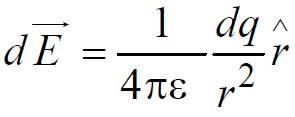 Non conducting sphere (dq is small charge element)
 dq = λdl (line charge density)
= σ ds (surface charge density)
= ρdv (volume charge density)
The net field strength due to entire charge distribution is given by
dq = λdl (line charge density)
= σ ds (surface charge density)
= ρdv (volume charge density)
The net field strength due to entire charge distribution is given by
 where the integration extends over the entire charge distribution.
Note:- Electric field intensity due to a point charge q, at a distance (r1 + r2) where r1 is the thickness of medium of dielectric constant K1 and r2 is the thickness of medium of dielectric constant K2 as shown in fig. is given by


CALCULATION OF ELECTRIC FIELD INTENSITY FOR A DISTRIBUTION OF DIRECT AND CONTINUOUS CHARGE
-
Fix origin of the coordinate system where electric field intensity is to be found.
-
Draw the direction of electric field intensity due to the surrounding charges considering one charge at a time.
-
Resolve the electric field intensity in x and y-axis respectively and find ΣEx and ΣEy
-
The resultant intensity is
 and
and  where θ is the angle between
  and x-axis.
-
To find the force acting on the charge placed at the origin, the formula F = qE is used.
ENERGY DENSITY
Energy in unit volume of electric field is called energy density and is given by
 ,
where E = electric field and εo= permittivity of vacuum
,
where E = electric field and εo= permittivity of vacuum
ELECTRIC FIELD DUE TO VARIOUS CHARGE DISTRIBUTION
-
Electric Field due to an isolated point charge


-
A circular ring of radius R with uniformly distributed charge

 When x >> R,
  [The charge on ring behaves as point charge]
E is max when
[The charge on ring behaves as point charge]
E is max when  . Also Emax
-
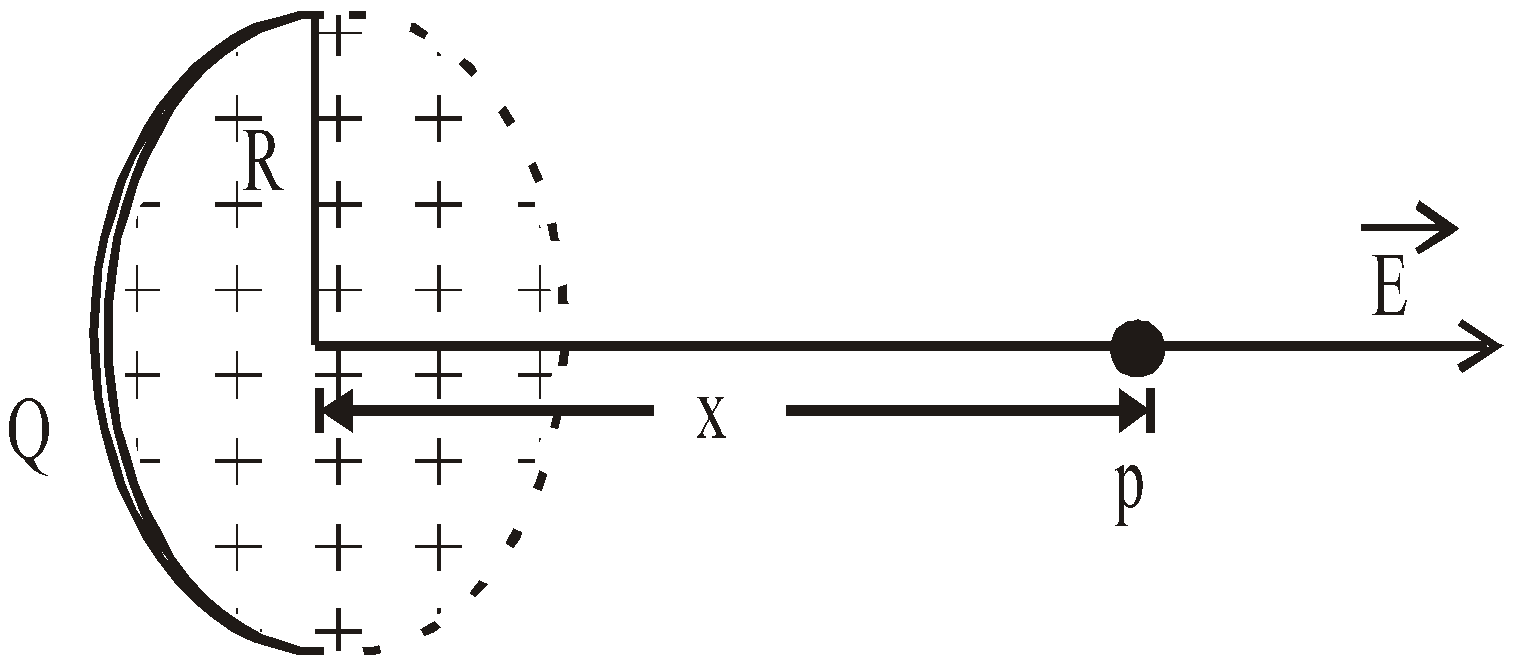
A circular disc of radius R with uniformly distributed charge with surface charge density σ

-
An infinite sheet of uniformly distributed charges with surface charge density σ
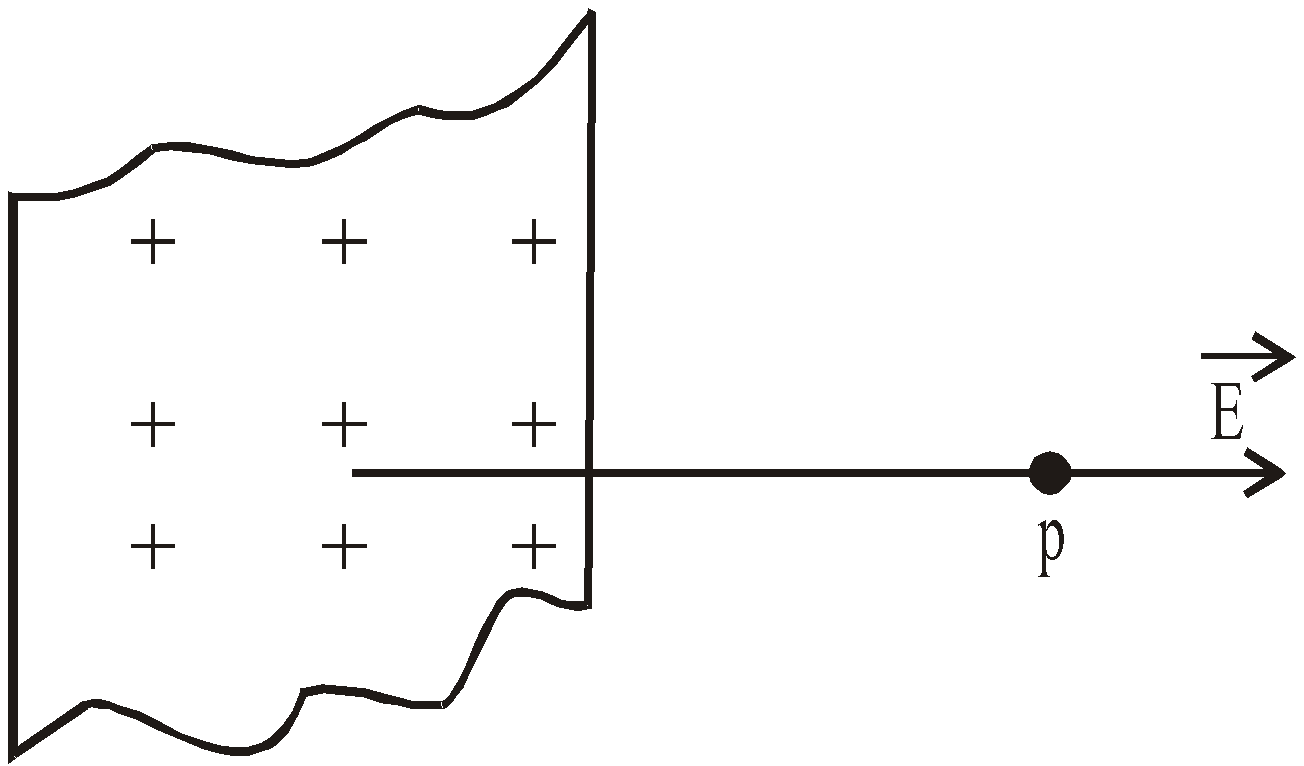

-
A finite length of charge with linear charge density

 and
and  Special case :
For Infinite length of charge,
Special case :
For Infinite length of charge,  ∴
∴  and
and 
-
Due to a spherical shell of uniformly distributed charges with surface charge density σ
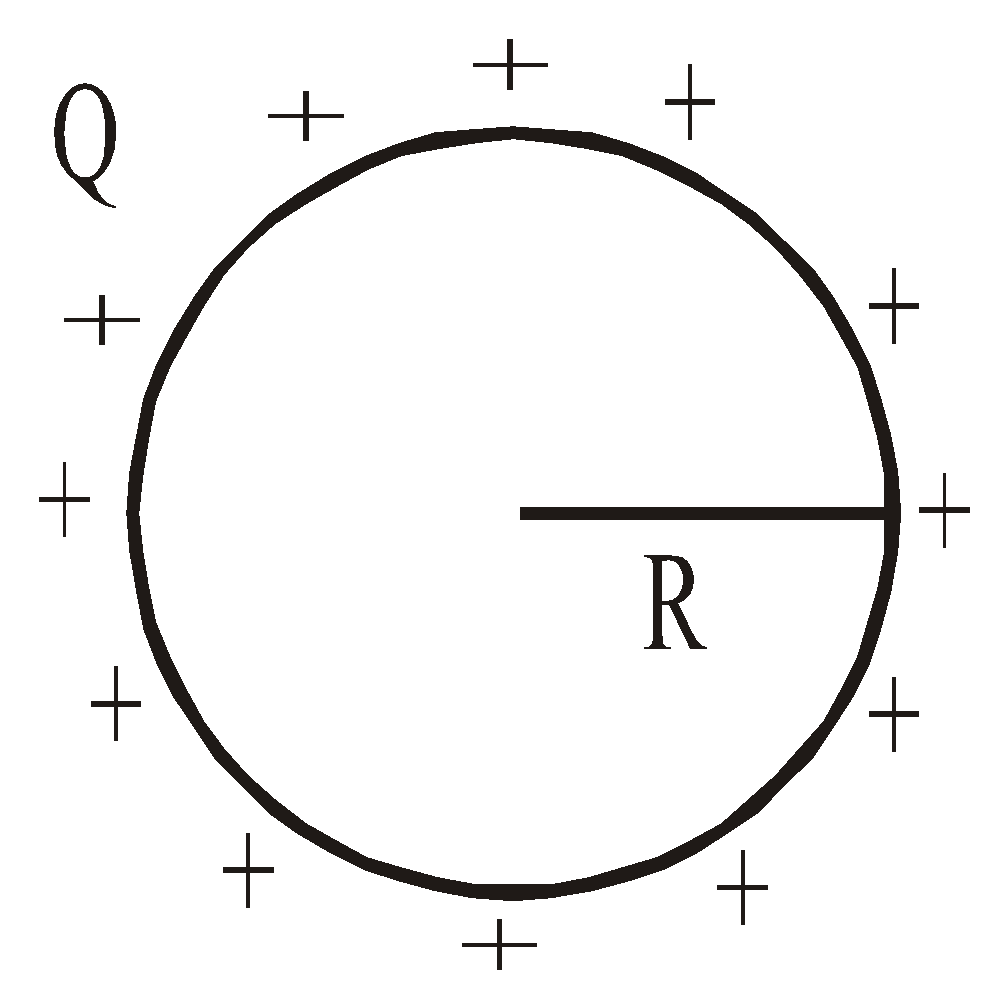
 Ein = 0 (x < R)


-
Due to a solid non conducting sphere of uniformly distributed charges with charge density ρ



-
Due to a solid non-conducting cylinder with linear charge density λ
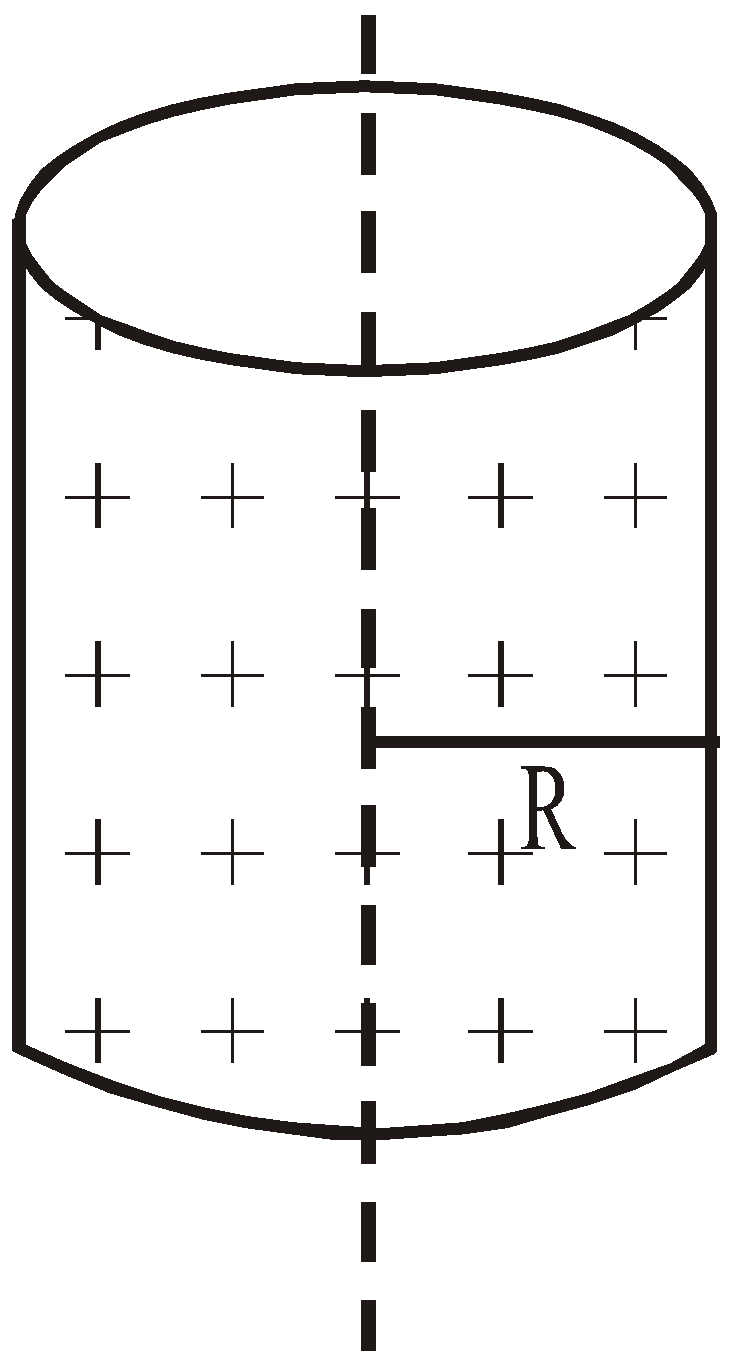 Eaxis = 0,
  ,
,
 ,
, In above cases,
KEEP IN MEMORY
-
If the electric lines of force are parallel and equally spaced, the field is uniform.
-
If E0 and E be the electric field intensity at a point due to a point charge or a charge distribution in vacuum and in a medium of dielectric constant K then
E = KE0
-
If E and E' be the electric field intensity at a point in the two media having dielectric constant K and K' then

-
The electric field intensity at a point due to a ring with uniform charge distribution doesn't depend upon the radius of the ring if the distance between the point and the centre of the ring is much greater than the radius of the ring. The ring simply behaves as a point charge.
-
The electric field intensity inside a hollow sphere is zero but has a finite value at the surface
 and outside it (
 ; x being the distance of the point from the centre of the sphere).
-
The electric field intensity at a point outside a hollow sphere (or spherical shell) does not depend upon the radius of the sphere. It just behaves as a point charge.
-
The electric field intensity at the centre of a non-conducting solid sphere with uniform charge distribution is zero. At other points inside it, the electric field varies directly with the distance from the centre (i.e. E ∝ x; x being the distance of the point from the centre). On the surface, it is constant but varies inversely with the square of the distance from the centre (i.e.
 ). Note that the field doesn't depend on the radius of the sphere for a point outside it. It simply behaves as a point charge.
-
The electric field intensity at a point on the axis of non-conducting solid cylinder is zero. It varies directly with the distance from the axis inside it (i.e. E ∝ x). On the surface, it is constant and varies inversely with the distance from the axis for a point outside it (i.e.
 ).
).
MOTION OF A CHARGED PARTICLE IN AN ELECTRIC FIELD
Let a charged particle of mass m and charge q be placed in a uniform electric field , then electric force on the charge particle is
  ∴ acceleration,
  (constant)
-
The velocity of the charged particle at time t is,
v = u + at = at =  (Particle initially at rest) or
-
Distance travelled by particle is


-
Kinetic energy gained by particle,

If a charged particle is entering the electric field in perpendicular direction.
 Let
Let  and the particle enters the field with speed u along x-axis.
Acceleration along Y-axis,
and the particle enters the field with speed u along x-axis.
Acceleration along Y-axis,  The initial component of velocity along y-axis is zero. Hence the deflection of the particle along y-axis after time t is ;

 …… (i)
Distance covered by particle in x-axis,
x = ut …… (ii) ( acceleration ax = 0)
Eliminating t from equation (i) & (ii),
…… (i)
Distance covered by particle in x-axis,
x = ut …… (ii) ( acceleration ax = 0)
Eliminating t from equation (i) & (ii),
 i.e. y ∝ x2.
This shows that the path of charged particle in perpendicular field is parabola.
If the width of the region in which the electric field exists be l then
i.e. y ∝ x2.
This shows that the path of charged particle in perpendicular field is parabola.
If the width of the region in which the electric field exists be l then

-
the particle will leave the field at a distance from its original path in the direction of field, given by

-
The particle will leave the region in the direction of the tangent drawn to the parabola at the point of escape.
-
The velocity of the particle at the point of escape is given b


-
The direction of the particle in which it leaves the field is given by


ELECTRIC DIPOLE
Two equal and opposite charges separated by a finite distance constitute an electric dipole. If –q and +q are charges at distance 2l apart, then dipole moment,
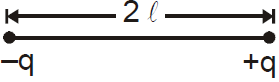
 Its SI unit is coulomb metre.
Its direction is from –q to +q. It is a vector quantity.
The torque τ on a dipole in uniform electric field as shown in figure is given by,
Its SI unit is coulomb metre.
Its direction is from –q to +q. It is a vector quantity.
The torque τ on a dipole in uniform electric field as shown in figure is given by, 
 So τ is maximum, when dipole is ⊥ to field & minimum (=0) when dipole is parallel or antiparallel to field.
If
So τ is maximum, when dipole is ⊥ to field & minimum (=0) when dipole is parallel or antiparallel to field.
If  and
and  Then
Then 
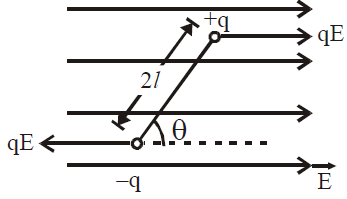
The work done in rotating the dipole from equilibrium through an angle dθ is given by
 and from θ1 → θ2,
If θ1 = 0 i.e., equilibrium position, then
 Work done in rotating an electric dipole in uniform electric field from θ1 to θ2 is W = pE (cosθ1 – cosθ2)
Potential energy of an electric dipole in an electric field is,
 i.e. U = –pE cosθ
where θ is the angle between
i.e. U = –pE cosθ
where θ is the angle between and
and  .
We can also write
.
We can also write 
ELECTRIC FIELD DUE TO AN ELECTRIC DIPOLE
-
Along the axial line (or end-on position)

 and
and  are parallel
 when x >> l
-
Along equatorial line (or broadside on position)

 when x >>l
When
when x >>l
When  and
and  are anti parallel then,
Eax = 2 Eeq
are anti parallel then,
Eax = 2 Eeq
-
At any point (from the dipole)

 ;
;  Electric field intensity due to a point charge varies inversely as cube of the distance and in case of quadrupole it varies inversely as the fourth power of distance from the quadrupole.
ELECTRIC FORCE BETWEEN TWO DIPOLES
The electrostatic force between two dipoles of dipole moments p1 and p2 lying at a separation r is
 when dipoles are placed coaxially
 when dipoles are placed perpendicular to each other.
KEEP IN MEMORY
-
The dipole moment of a dipole has a direction from the negative charge to the positive charge.
-
If the separation between the charges of the dipole is increased (or decreased) K-times, the dipole moment increases (or decreases) by K-times.
-
The torque experienced by a dipole placed in a uniform electric field has value always lying between zero and pE, where p is the dipole moment and E, the uniform electric field. It varies directly with the separation between the charges of the dipole.
-
The work done in rotating a dipole in a uniform electric field varies from zero (minimum) to 2pE (maximum). Also, it varies directly with the separation between the charges of the dipole.
-
The potential energy of the dipole in a uniform electric field always lies between +pE and –pE.
-
The electric field intensity at a point due to an electric dipole varies inversely with the cube of the distance of the point from its centre if the distance is much greater than the length of the dipole.
-
The electric field at a point due to a small dipole in end-on position is double of its value in broad side-on position,
i.e. EEnd-on = 2EBroad side-on
-
For a small dipole, the electric field tends from infinity at a point very close to the axis of the dipole to zero at a point at infinity.
-
The force between two dipoles increases (or decreases) by K4-times as the distance between them decreases (or increases) by K-times.
-
Time period of a dipole in uniform electric field is
 where I = moment of inertia of the dipole about the axis of rotation.
ELECTRIC FLUX
Electric flux is a measure of the number of electric field lines passing through the surface. If surface is not open & encloses some net charge, then net number of lines that go through the surface is proportional to net charge within the surface.
For uniform electric field when the angle between area vector  and electric field
  has the same value throughout the area,

 For uniform electric field when the angle between the area vector and electric field is not constant throughout the area


KEEP IN MEMORY
-
The electric flux is a scalar although it is a product of two vectors
 and
and  (because it is a scalar product of the two).
-
The electric flux has values lying between –EA and +EA, where E and A are the electric field and the area of cross-section of the surface.
GAUSS'S LAW
It states that, the net electric flux through a closed surface in vacuum is equal to 1/εo times the net charge enclosed within the surface.
i.e.,  where Qin represents the net charge inside the gaussian surface S.
 Closed surface of irregular shape which enclosed total charge Qin
In principle, Gauss's law can always be used to calculate the electric field of a system of charges or a continuous distribution of charge. But in practice it is useful only in a limited number of situation, where there is a high degree of symmetry such as spherical, cylindrical etc.
-
The net electric flux through any closed surface depends only on the charge inside that surface. In the figures, the net flux through S is q1/εo, the net flux through S’ is (q2 +q3 )/εo and the net flux, through S" is zero.


 A point charge Q is located outside a closed surface S. In this case note that the number of lines entering the surface equals to the number of lines leaving the surface. In other words the net flux through a closed surface is zero, if there is no charge inside.

-
The net flux across surface A is zero
 i.e.,
i.e.,  because Qin = – q + q = 0
APPLICATIONS OF GAUSS’S LAW
-
To determine electric field due to a point charge
 The point charge Q is at the centre of spherical surface shown in figure.
Gaussian surface and is parallel to (direction normal to Gaussian surface) at every point on the Gaussian surface.
so, 


-
To determine electric field due to a cylindrically symmetric charge distribution
 We calculate the electric field at a distance r from a uniform positive line charge of infinite length whose charge per unit length is λ = constant. The flux through the plane surfaces of the Gaussian cylinder is zero, since is parallel to the plane of end surface (is perpendicular to ). The total charge inside the Gaussian surface is λl, where λ is linear charge density and l is the length of cylinder.
Now applying Gauss’s law and noting is parallel to everywhere on cylindrical surface, we find that
We calculate the electric field at a distance r from a uniform positive line charge of infinite length whose charge per unit length is λ = constant. The flux through the plane surfaces of the Gaussian cylinder is zero, since is parallel to the plane of end surface (is perpendicular to ). The total charge inside the Gaussian surface is λl, where λ is linear charge density and l is the length of cylinder.
Now applying Gauss’s law and noting is parallel to everywhere on cylindrical surface, we find that

KEEP IN MEMORY
-
The closed imaginary surfaces drawn around a charge are called Gaussian surfaces.
-
If the flux emerging out of a Gaussian surface is zero then it is not necessary that the intensity of electric field is zero.
-
In the Gauss's law,

 is the resultant electric field due to all charges lying inside or outside the Gaussian surface, but Qin is the charge lying only inside the surface.
-
The net flux of the electric field through a closed surface due to all the charges lying inside or outside the surface is equal to the flux due to the charges only enclosed by the surface.
-
The electric flux through any closed surface does not depend on the dimensions of the surface but it depends only on the net charge enclosed by the surface.
i.e., the sum of positive charges is equal to the sum of negative charges.
(Pair-annihilation process)This is also called charge invariance with motion
or = 9 × 10⁹ Nm2 C–2. in CGS system of unit. charges becomes 1/K times when placed in a medium of
dielectric constant K.
is calculated by integrating under proper limits. is a variable unit vector which points from each dq, towards the location of charge q1 (where dq is a small charge element); ρ has unit coulomb/m3. σ has unit coulomb / m2, λ has unit coulomb/m. and and the direction is given by newton) from that charge is defined asis the force experienced by a small positive test charge q0 due to charge q. are the electric field intensities due to charges q1, q2, q3.....respectively. - close together, the field is strong (see fig.1)
- far apart, the field is weak (see fig.2)
and where θ is the angle between and x-axis.Energy in unit volume of electric field is called energy density and is given by
, . Also Emax and and , ,and outside it (; x being the distance of the point from the centre of the sphere).). Note that the field doesn't depend on the radius of the sphere for a point outside it. It simply behaves as a point charge.)., then electric force on the charge particle is (constant) (Particle initially at rest) or and the particle enters the field with speed u along x-axis.…… (i) i.e. y ∝ x2. and i.e. U = –pE cosθand . and are parallel when x >> l when x >>l and are anti parallel then,; when dipoles are placed coaxially when dipoles are placed perpendicular to each other.and electric field has the same value throughout the area, and (because it is a scalar product of the two). Gaussian surface and is parallel to (direction normal to Gaussian surface) at every point on the Gaussian surface.
is the resultant electric field due to all charges lying inside or outside the Gaussian surface, but Qin is the charge lying only inside the surface.